DIFFERENCE26-01 What is Historic Biblical Christianity?
00:00
There is a question you have probably heard — and maybe quietly wondered yourself: don't all religions basically teach the same thing?
Your colleague at work believes it. Your neighbor assumes it. Your college student is being handed it as settled fact.
For many Christians, it has become the most uncomfortable question of their faith.
This summer, we are starting a new series here at Pathway.
It is called:
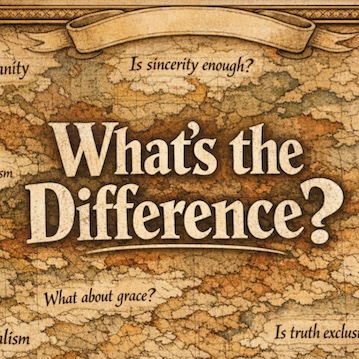
What's the Difference?
Today is Talk #1 of 12. Today's talk is called:
The Christian Map: What Is Historic Biblical Christianity?
We are going to do something many churches never do — look at the major belief systems of the world and ask one honest question: What's the difference?
We will examine Roman Catholicism, Eastern Orthodoxy, Islam, Buddhism, Hinduism, New Age spirituality, secular humanism, Jehovah's Witnesses, Mormonism, and more. Respectfully, seriously, and without mockery.
Our approach:
We will steelman every tradition before we critique it. A steelman argument is the opposite of a straw man argument. It means I want to present each system at its best, the way a thoughtful, sincere follower would present it.
We will acknowledge what each tradition gets right — the genuine human longing it addresses, the real beauty it contains.
And then we will ask: What's the difference?
By the end of this series, many of you will have something you may not have had before: LANGUAGE.
Clear, bold, wise, kind, confident language for the conversations you are already having.
If you are navigating a pluralistic workplace and want to hold your convictions without sounding intolerant — this series is for you.
If you are a parent and your kids are coming home with questions you cannot answer — this series is for you.
If you have ever wondered whether your faith can survive your hardest questions — stay for this.
Throughout this series, I want to build a case — one that historians, skeptics, and people with no theological reason to be generous have made — that...
"No movement in human history has done as much good for the world, societal, humanitarian, civilizational, and psychological good as historic biblical Christianity."
And at the end of every talk, we will arrive at the same answer. Not a system. Not a set of rules. Not a philosophy. A Person — and the one thing He offers that nothing else on earth can.
But today, we start with Paul in Athens.
"For as I was passing through and considering the objects of your worship, I even found an altar with this inscription: TO THE UNKNOWN GOD. Therefore, the One whom you worship without knowing, Him I proclaim to you." (Acts 17:23)
Paul in Athens
The year is approximately AD 50. Paul arrives in Athens — the most intellectually sophisticated city in the ancient world. Home of Socrates, Plato, and Aristotle. A city whose architecture still inspires awe twenty-one centuries later.
"Now while Paul waited for them at Athens, his spirit was provoked within him when he saw that the city was given over to idols." (Acts 17:16)
In the Athens Paul enters, the religious landscape is overwhelming... Paul walks in, and his spirit is "provoked." That word in the original Greek is paroxynō. It's where we get our word "paroxysm." This wasn't mild irritation; it was a sharp, painful, grievous agitation. He wasn't filled with contempt at them; he was in pain for them. He sees a city that has reached the absolute heights of human achievement and still has not found the God it is desperately looking for.
He doesn't stand on a corner and yell. He dialogues — the Greek word is dialegomai, a give-and-take of ideas, a conversation, a real Q&A. He finds out what people already believe. He looks for the open door.
Paul was a scholar's scholar. A thinker, a philosopher, a student of every tradition available to him. He had spent a lifetime studying God, theology, and truth. And then, in one defining moment, everything he thought he knew was turned upside down.
That was the moment he met Jesus Christ — his arch-enemy, risen from the dead.
Jesus did not wait for Paul to come to him. He pursued him. Chased him down. Stopped him on a road.
And Paul, the most formidable intellect in his generation, was undone — not by a better argument, but by a living Person whose cross had already purchased everything Paul owed.
He found what he had been looking for. And he could never be the same again.
Jesus became his north star — his everything when it came to faith, hope, meaning, logic, transcendence, truth, and life.
To Paul, Jesus was...
The Creator of the cosmos.
The centerpiece of history.
The Savior of his soul, and...
The Savior of the world.
The resolution of every dilemma, and...
The hope of every longing heart.
Paul knew this. He felt it. He lived it.
And now Paul stands in this place of overwhelming religious pluralism. And when he looks beneath it — beneath the marble and the gold and the philosophy — he sees in the Athenians exactly what he had once seen in himself.
Why had he been so zealous to persecute Christians?
Why was he so urgent in his religion?
What was driving the best of the best to run so hard in the wrong direction?
The answer is the same for Paul as it was for Athens — and you can say it in one word.
The human heart — many hearts, perhaps your heart — is restless. On a quest for meaning, for reality, for something that holds.
There's a desperation deep inside.
That restlessness is not a flaw. It is a signal. It is pointing somewhere.
And nowhere is this more visible than the altar Paul finds that stops him cold. Among thousands of idols to known gods, one inscription:
"For as I was passing through and considering the objects of your worship, I even found an altar with this inscription: TO THE UNKNOWN GOD. Therefore, the One whom you worship without knowing, Him I proclaim to you." (Acts 17:23)
They were so desperate. They were so afraid they had to cover all the bases. There might be a god they missed.
I think that inscription — TO THE UNKNOWN GOD — is engraved on the altar of every longing heart that has ever searched for something real and come up empty.
Paul knows exactly who that God is. And so do we.