EASTER26-01 The Mystery of the Missing Stone
00:00
It's over.
The dream is dead. The man who was supposed to be their leader, their Messiah, King, Rescuer... he is gone. Executed like a common criminal.
For three days, a suffocating silence has fallen over Jerusalem. The small band of disciples is crushed. Scattered, hiding behind locked doors, their hope shattered into a million pieces. All that's left is the grim, final task of properly anointing the body.
So in the pre-dawn darkness, a small group of women makes their way through the cold, silent streets. The Gospels name them: Mary Magdalene, Mary the mother of James, Salome, and Joanna. They aren't going to the tomb expecting a miracle. They are going expecting a corpse. They are carrying spices for the dead, their hearts as heavy as the burial spices in their hands.
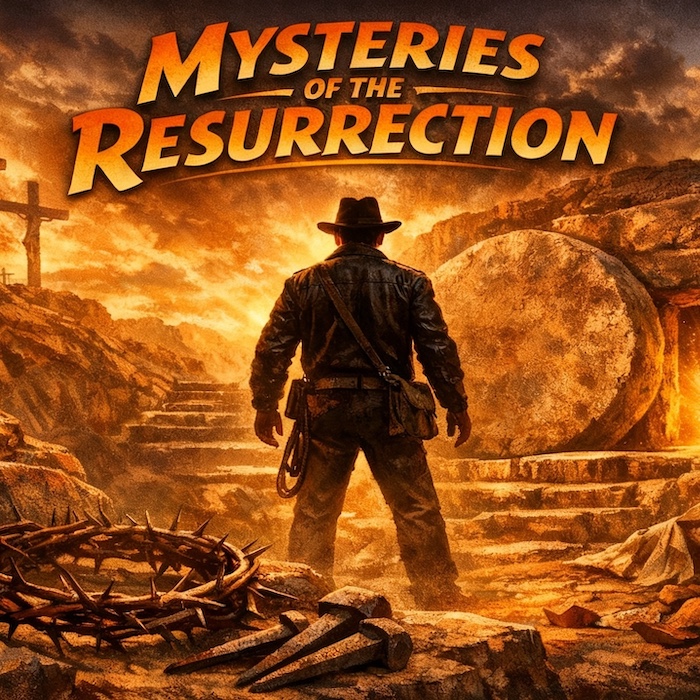
They know what they're going to find. A rock-hewn tomb, carved into the side of a hill. And blocking its entrance, a massive, circular stone. Think of a stone the size of a car, weighing between one and two tons—that's the weight of a car—solid rock, wedged into a channel, sealing the grave shut.
This stone wasn't just a door. It was a statement. It was the full stop at the end of the sentence. It was a declaration of finality. It said: "This is permanent. This is over. There is no coming back from this."
As they get closer, their minds are racing with a practical, heartbreaking question: "Who will roll the stone away for us?" It would take a crew of strong men to budge it. How could they possibly get inside?
But as the first hints of dawn break over the horizon, they see it. And they stop. Their blood runs cold. Everything inside of them freezes.
Because the problem isn't that the stone is too big to move.
The problem is... it's already gone.
It hasn't been chipped away. It hasn't been cracked open. It's been... moved. Rolled away. Uphill. As if some cosmic giant just picked it up and shoved it away. The impossible has happened.
And in that moment, standing before that gaping, open tomb, Mary is confronted with the first great mystery of the resurrection. Forget the body for a moment. Before we can even ask, "Where is Jesus?", we have to ask a more immediate, a more shocking question:
Who moved the stone?
"Now behold, there was a man named Joseph, a council member, a good and just man. He had not consented to their decision and deed. He was from Arimathea, a city of the Jews, who himself was also waiting for the kingdom of God. This man went to Pilate and asked for the body of Jesus. Then he took it down, wrapped it in linen, and laid it in a tomb that was hewn out of the rock, where no one had ever lain before. That day was the Preparation, and the Sabbath drew near. And the women who had come with Him from Galilee followed after, and they observed the tomb and how His body was laid. Then they returned and prepared spices and fragrant oils. And they rested on the Sabbath according to the commandment. Now on the first day of the week, very early in the morning, they, and certain other women with them, came to the tomb bringing the spices which they had prepared. But they found the stone rolled away from the tomb." (Luke 23:50-24:2)
The Mystery of the Missing Stone
Today, I'm launching a brand-new series.
It's called The Mysteries of the Resurrection.
From now through Easter we are going to become investigators. We are going to put on our detective hats and lean into the single most important event in human history: the resurrection of Jesus Christ from the dead.
And here's the promise I want to make to you for this series: if you will honestly investigate the resurrection of Jesus with us, you will discover that His resurrection is a fact of history backed by many infallible proofs.
But it doesn't stop there.
You will also discover the resurrection of Jesus is not just historical fact, it's also personal enablement.
It is a power you can rely on.
It's Breakthrough Power. Because the same power that raised Jesus from the dead can raise hope, heal hurts, strengthen resolve, and give you a purpose that goes beyond anything this world can offer.
So today, we begin with that first, staggering mystery: the mystery of the missing stone.
"Now behold, there was a man named Joseph, a council member, a good and just man. He had not consented to their decision and deed. He was from Arimathea, a city of the Jews, who himself was also waiting for the kingdom of God. This man went to Pilate and asked for the body of Jesus. Then he took it down, wrapped it in linen, and laid it in a tomb that was hewn out of the rock, where no one had ever lain before. That day was the Preparation, and the Sabbath drew near. And the women who had come with Him from Galilee followed after, and they observed the tomb and how His body was laid. Then they returned and prepared spices and fragrant oils. And they rested on the Sabbath according to the commandment. Now on the first day of the week, very early in the morning, they, and certain other women with them, came to the tomb bringing the spices which they had prepared. But they found the stone rolled away from the tomb." (Luke 23:50-24:2)
The Impossible Crime Scene
Before you can solve a mystery, you have to understand the crime scene. And I want you to understand just how perplexing this scene was. The authorities in that day—both Roman and Jewish—took extreme measures to make sure that tomb stayed closed.
There were three layers of security.
Three obstacles to anybody opening the tomb:
OBSTACLE 1:
First, you had the stone itself. I already mentioned it was heavy—weighing up to 4,000 pounds.
But it wasn't just heavy. It was strategic. These stones were often rolled down a slanted groove to seal the tomb's entrance. That means closing the tomb was easy—gravity did most of the work.
But opening it? You would have to roll a two-ton stone uphill, out of its groove. This wasn't a job for one person. It wasn't a quiet job. It was a loud, difficult, multi-person job requiring immense, coordinated effort.
Obstacle number one: The sheer weight of the stone.
OBSTACLE 2:
Second, you had the Roman Guard. Now, I need you to get the image of a sleepy mall cop out of your head.
This was a Roman military unit of 4 to 16 soldiers. These were disciplined, professional soldiers from the toughest army on the planet.
Their job was simple: keep that tomb sealed. And for a Roman soldier, failure was not an option.
Their job was simple: keep that tomb sealed. And for a Roman soldier, failure was not an option.
Falling asleep at your post? The punishment was death.
Letting a prisoner escape? The punishment was death.
They had one job, and their life depended on doing it.
Obstacle number two: A highly-trained, heavily-armed military detail.
OBSTACLE 3:
And third, you had the Roman Seal. Matthew tells us the authorities "made the tomb secure by putting a seal on the stone." What was that?
That was a cord stretched across the stone and fastened to the tomb wall with wax, stamped with the official insignia of the Roman governor.
This seal was a symbol of the full power and authority of the Roman Empire. To break that seal was not just vandalism; it was treason. It was like spitting in the face of Caesar. It was an act of rebellion against Rome itself.
Obstacle number three: The undisputed authority of an empire.
So I want you to picture this. You have a two-ton stone, guarded by a squad of elite soldiers, backed by the full authority of Rome.
This wasn't just a "No Trespassing" sign. It was a fortress. It was humanity's version of maximum security.
And on Sunday morning, the stone was cast aside like a kid kicking a stone down a sidewalk. The guards were gone. The seal was broken.
So, the question stands. Who did it?