DIFFERENCE26-05 Mainstream Protestantism
00:00
You probably know I'm a city boy. I spent most of my life in the City of Chicago as a pastor.
I grew up there, and I began ministry there. I also spent a full year in seminary (that's just a master's degree for pastors) studying urban systems, leadership, and ministry. So part of my schooling is a graduate certificate in urban ministry leadership.
I earned this certificate in downtown Chicago in a program called SCUPE (Seminary Consortium for Urban Pastoral Education).
This was a program where students came from different seminaries from all over the US and Canada. We met up for a one year urban plunge and intense training.
We slept overnight in missions, ate in soup kitchen, prayed with people on the streets in the roughest neighborhoods in Chicago, and studied theology in the light of urban experience.
One hard thing about this program was that of all the students there, only three of us were solidly evangelical in our theology... in that place of historic biblical Christianity, aka evangelicalism.
The rest of my cohort were theologically liberal. Here's what that sounds like.
For example, the President of SCUPE began a prayer saying, "We pray to the Supreme Being whoever he or she may be."
To him, God was our Holy Mother, and the goddess of earth.
Another example, the most common teaching in this program was universalism, the teaching that all roads lead to God.
We were taught theological perspectives called Liberation Theology, 70's Radical Feminist Theology, and Social Gospel Postmillennialism.
Another of my professors came from a seminary that also taught Wicca.
Jesus was portrayed as liberator and social justice prophet more than as an atoning sacrifice for sin.
In fact, sin was defined as a systemic problem in the power structures of society, not as a corruption cutting through every human heart.
So that was my one year urban program.
I was stressed out that whole year.
You have to understand that I went through this program in my 20s. I grew up with a very conservative biblical theology from childhood.
So, this whole year forced me to question everything.
But it was so stressful for me. So I came up with a way of re-stabilizing my own evangelical theology every time I went to SCUPE.
It had to do with where I parked.
Scupe met a few blocks from another school in downtown Chicago called Moody Bible Institute. This was named after a famous evangelist named Dwight Moody in the 1800s.
Moody Bible Institute was like a headquarters for conservative evangelical theology.
So I always parked my car on the far side of Moody, near the Cabrini Green housing projects, a rough neighborhood.
But I did this so that on my way to school, I could walk through the Moody campus and breathe the evangelical air. Then, on my way back to my car I could walk through the Moody campus and get recentered.
I also prayed that my car would still be there.
Hopefully with all the tires.
I'm saying I have lived in this world of liberal theology.
I understand the thinking. I understand the theology. I was the valedictorian of my cohort. I understand the people. I love them. I made really great friendships.
And I came out more convinced than ever before that the Word of God is true, the Gospel is the only way of salvation, because Jesus Christ, crucified and risen again, is the only Savior and only hope of the world, and when I pray, I bow my knee to the Creator God who is a Trinity and the Father of our Lord Jesus Christ.
That's just my street cred for this sermon.
Welcome to our summer series at Pathway.
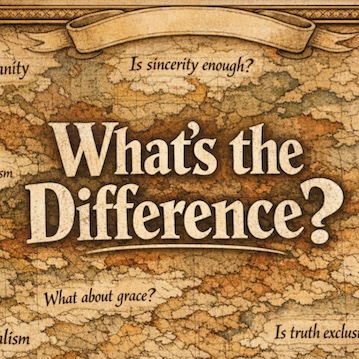
The series is called "What's the Difference?"
We recognize there's a wide variety of systems that claim the label of Christian.
And there are many other systems that are not on the Christian map at all.
So we're asking "What's the Difference?"
And we're doing this with love and respect. And also with a clear-eyed view that there are differences and that many of these make other viewpoints incompatible with the claims of Christ.
"Beloved, while I was very diligent to write to you concerning our common salvation, I found it necessary to write to you exhorting you to contend earnestly for the faith which was once for all delivered to the saints." (Jude 1:3)
Dangerous Drifts in Mainstream Protestantism
My talk today is about the version of Christianity I experienced at SCUPE.
This is called Mainstream Protestant Christianity.
This includes many churches you might see with names like:
The United Church of Christ
The Episcopal Church
The Evangelical Lutheran Church in America
Presbyterian Church (USA)
The United Methodist Church
Disciples of Christ
American Baptist Churches
In fact, these seven specific groups of churches are called The Seven Sisters. They are described as: "theologically and politically liberal and pluralistic."
Areas of Agreement
Before I diagnose the problem, I want to acknowledge what's genuinely good in the mainline tradition.
First, there's the commitment to inclusion and compassion.
Mainline churches have championed care for the poor, advocacy for the marginalized, and a faith that actually touches the physical world and not just the soul.
Second, there's intellectual rigor.
Mainline seminaries have produced some of the most sophisticated scholarship in history. The University of Chicago Divinity School, Union Theological Seminary, Princeton Theological Seminary — these institutions have engaged in theological thinking at the highest academic levels.
Third, there's a deep liturgical and sacramental heritage.
Many mainline churches retained a liturgical richness that evangelical churches lost in the name of authenticity and simplicity. The Book of Common Prayer, the Methodist liturgical traditions, the Reformed confessional standards — there's genuine theological depth there.
That being said, there are some major problems with these churches... and I want to lay them out... with all love and all respect.
Four ways they have drifted.
Drift 1: The Bible Gets Demoted
The Mainstream Protestant Viewpoint
The Bible gets demoted from God's final Word to a spiritual resource.
The Bible may still be present. It may still be read in worship. It may still be quoted in sermons. It may still be carried in procession, printed in bulletins, and placed on church websites. But it's alongside modern scholars and poets, as if they were equal.
In the mainstream tradition, you will hear things like this:
"Yes it had discrepancies, contradictions, historical errors, glaring scientific mistakes, and so on. Of course it did." — Bart D. Ehrman, Appreciating the Myths of the Bible
"The Bible is a human product: it tells us how our religious ancestors saw things, not how God sees things. As such, it contains stories that never happened and statements that are not factually true." — Marcus J. Borg, Reading the Bible Again for the First Time (2001)
Once you say that the Bible has errors, you begin to allow other voices to climb to the top of the hill.
And supreme among them is the voice of culture. What does our culture say is right or good or true or moral... that becomes the measuring stick, not the Bible.
The issue is whether or not you will set your viewpoint above the Bible or the Bible's viewpoint above yours. That is not an easy question.
Can Scripture correct your politics? Can Scripture correct your sexual ethics? Can Scripture correct your definition of justice? Can Scripture correct your assumptions about God, sin, salvation, judgment, heaven, and hell?
Because if the Bible can only say what the culture already approves, then the Bible is no longer functioning as authority.
It is functioning as decoration.
And that is the hallmark of these mainstream churches.
The Evangelical Response
The evangelical response is a hard no to this demotion of Scripture.
Evangelicals believe in the inerrancy and authority of Scriptures.
This dividing line is the essence of historic biblical Christianity. No mistakes. No errors. And nothing gets tossed out because it is culturally out of date...
So the Bible says:
"All Scripture is given by inspiration of God, and is profitable for doctrine, for reproof, for correction, for instruction in righteousness..." (2 Timothy 3:16)
"Much in every way! Chiefly because to them [the Jews] were committed the oracles of God." (Romans 3:2)
Jesus said, "The Scripture cannot be broken." (John 10:35)
Inerrancy is the platform on which all other truths we believe are built and stabilized.
What confidence can we have in a secure salvation if the Word that proclaims it is insecure?
"And so we have the prophetic word confirmed, which you do well to heed as a light that shines in a dark place, until the day dawns and the morning star rises in your hearts." (2 Peter 1:19)
No matter what church you go to, ask them if they believe in the inerrancy of Scriptures. If they say no, I lovingly say to find another church.
If they get evasive, and say "we prefer to say the infallibility of Scripture," I say to find another church.
Once the Bible gets demoted, everything else becomes negotiable.